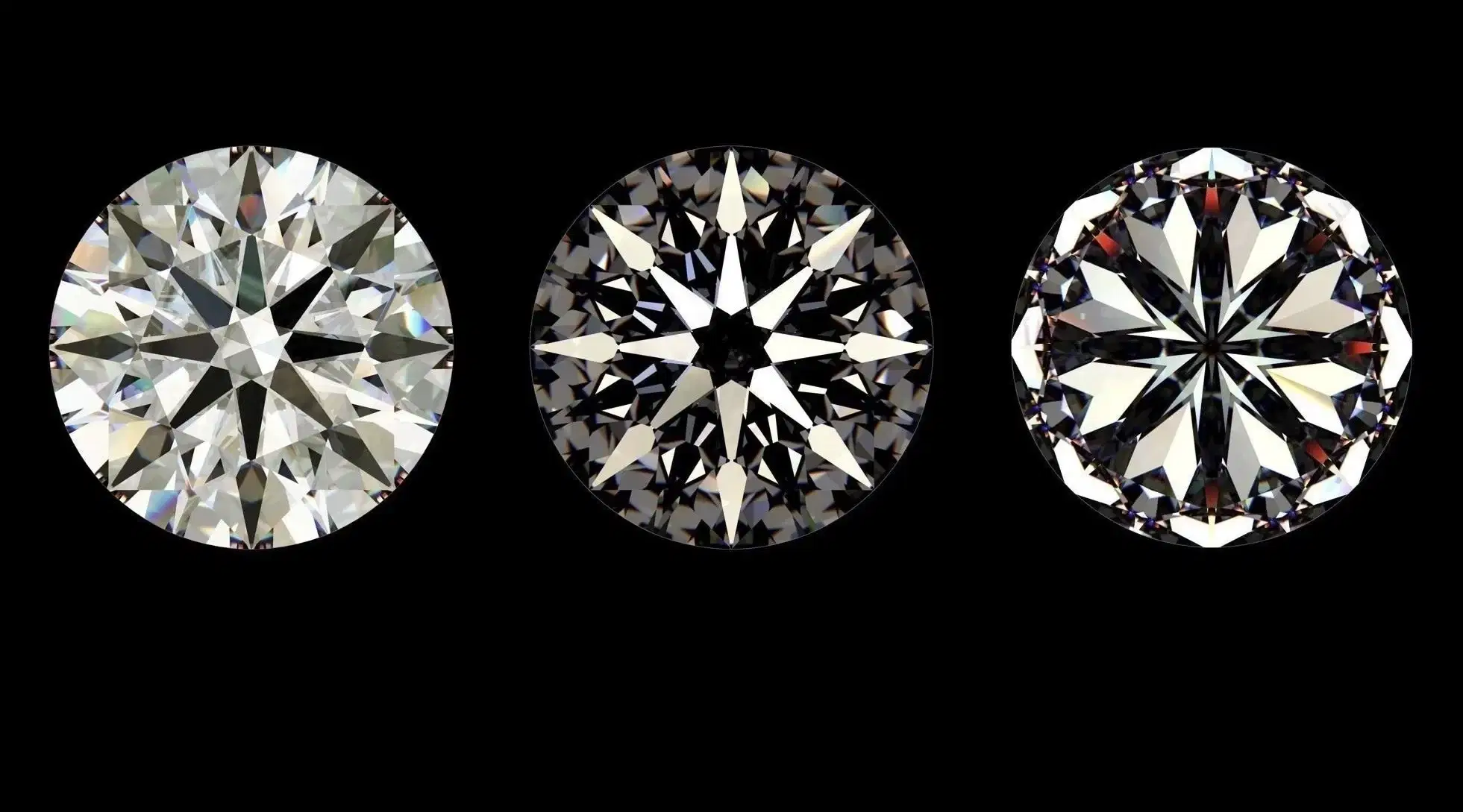
Diamond Proportions: Excellent vs. Super Ideal Cut Diamonds
Posted by Sharif Khan on 6th Jun 2022
Ideal Cut Diamond Proportions

The way a diamond is cut significantly influences its ability to emit optimal brilliance (white light), fire (color light), and scintillation (sparkle). To determine the diamond's cut quality, evaluate its proportions.
Follow the following ideal cut diamond proportions for round and non-round fancy shaped diamonds. Since the Gemological Institute of America (GIA) does not assign a cut grade to fancy shaped stones, such as princess cuts or cushion cuts, these proportions become particularly crucial in evaluating the cut quality of such diamonds.
This guide also delineates parameters for distinguishing between ideal and super ideal proportions, specifically for round cut diamonds. Understanding and applying these proportions can aid in selecting diamonds with exceptional cut quality, ensuring they exhibit the most captivating beauty and sparkle.
Evaluate these proportions with these 40X Diamond MAGNIFIED VIDEOS.
Round Super Ideal Cut Proportions
Crown angle and pavilion depth play a significant role in picking a super ideal cut diamond from an ideal cut diamond. These two factors can help distinguish be two round cut diamonds with an equally excellent cut, symmetry, and polish grade from GIA. These proportions also apply to lab-created diamonds.
| Cut | Depth% | Table% | Crown Angle | Pavilion Angle | Girdle |
| Super Ideal Round Cut | 60-62.1% | 54-58% | 33.9-34.9 | 40.2-41 | Thin - Slightly Thick (2-3.5%) |
| Ideal Round Cut | 59-62.8% | 53-59% | 33.9-35.5 | 40-42 | Thin - Slightly Thick (1.5-4%) |
Polish
VG to Excellent for Ideal and Excellent for Super Ideal
Symmetry
VG to Excellent for Ideal and Excellent for Super Ideal

Check these TRUE HEART, ASTOR IDEAL CUT, and A CUT ABOVE diamonds for their brilliance, fire, and sparkle.
Fancy Shape Ideal Cut Proportions
| Cut |
Depth% |
Table% |
Girdle |
Culet |
Length to Width Ratio |
|
Ideal Princess Cut |
64-73 |
62-69 |
Thin-Slightly Thick |
None to Very Small |
Square: 1.00-1.05 |
|
Rectangular: 1.49 -1.73 |
|||||
|
Ideal Oval Cut |
57-62 |
53-64 |
Thin - slightly thick |
None to Very Small |
1.4-1.55 |
|
Ideal Radiant Cut |
61-67 |
62-70 |
Thin - slightly thick |
None to Very Small |
Square: 1.00-1.05 |
|
Rectangular: 1.20 -1.31 |
|||||
|
Ideal Cushion Cut |
61-67 |
61-68 |
Thin - slightly thick |
None to Very Small |
Square: 1.00-1.05 |
|
Rectangular: 1.2 -1.25 |
|||||
|
Ideal Emerald Cut |
61 - 67 |
62-70 |
Thin - slightly thick |
None to Very Small |
Square: 1.00-1.05 |
|
Rectangular: 1.39 -1.50 |
|||||
|
Ideal Asscher Cut |
61-67 |
62-70 |
Thin - slightly thick |
None to Very Small |
1.00-1.05 |
|
Ideal Marquise Cut |
57-62 |
53-64 |
Thin - slightly thick |
None to Very Small |
1.8-2.05 |
Balancing Cut Within the 4Cs
While the cut is undeniably essential, the brilliance of a diamond is influenced by all 4Cs - cut, color, clarity, and carat weight. Ideally, achieving super ideal cut proportions without compromising the other 3Cs is the best approach. However, while striking a balance between the 4Cs, prioritizing the cut grade is important.
It is acceptable for the proportions to be slightly higher or lower, and according to GIA (Gemological Institute of America), we can model these proportions slightly differently and still achieve the same level of brilliance. A 0.2-0.3% tolerance up or down from the super ideal proportions range is acceptable.
Learn more about the importance of cut among the 4Cs.

Achieving Ultimate Brilliance
Brilliance is hailed as the ultimate factor in determining the overall beauty of a diamond.
GIA refers to brilliance as "the intensity of the internal and external reflections of white light to the eye from a diamond or other gem in the face-up position" and measures it in terms of Weight Light Return (WLR).
After many studies and models, the industry has come to some consensus around the proportions of a diamond that will establish the quality of its cut. Cut plays an important role in determining the brilliance of a diamond. For example, it might be helpful to check these proportions for a round or cushion shape stone and see how they play a role in determining their cut.
The findings of GIA's study are rather interesting. It indicates that while proportions, such as the ones developed by Marcel Tolkowsky for an ideal cut diamond, are important, a diamond does not need to be within these rigid parameters to obtain an optimal level of brilliance. Put differently, it could be argued that there are many ways to proportion a diamond for maximum brilliance. These findings confirm the commonly held view among cutters that a diamond does not need a prescribed depth or table (among other factors) to look as brilliant as one that meets rigid parameters. Proportion can be modeled differently to achieve optimal brilliance.
The key takeaway from these findings is that while these parameters are essential, they can only take us so far. We should not mark diamonds that are not precisely within the proportions of one grading model as inferior without inspecting their visual appearance. In some cases, their visual appearance might surpass the brilliance of one with ideal proportions. The issues of fire and scintillation should also be considered while evaluating the overall brilliance of diamonds.
Our advice to shoppers would be not to spend too much time on the issue of brilliance, as it is an advanced and confusing topic for regular consumers to grasp quickly. Instead, we recommend using the GIA or AGS grading systems and trusting their assessment. Since GIA does not offer a cut grade for shapes other than round, follow our general diamond guide for each shape of a diamond to get a well-cut stone.

GIA's Look into Brilliance
In the late 1990s, the Gemological Institute of America (GIA) conducted a study of brilliance. The most important insight from the study was that the proportions of a diamond could be modeled differently to achieve the same level of optimal brilliance.
The term "brilliance" refers to the brightness of a diamond and is determined by the amount of light reflected from within. Here is how it works: light enters the diamond through the "table" or the top and moves through a spectrum of colors as it bounces off the mirror-like facets and runs across the interior. When the light leaves the diamond, it is reflected in the eye.
In their Diamond Dictionary, GIA defines brilliance as "the intensity of the internal and external reflections of white light to the eye from a diamond or other gem in the face-up position." Cutting facets ultimately create brilliance, typically performed with a faceting machine. The ideal facet cut will produce the highest brilliance possible from the stone. If an expert artisan cuts the facets, there will be no light loss when reflected in a diamond. The less light reflected from the eye, the lower the stone's brilliance. Light is lost when the angle of the facets shoots the light upward or downward, resulting in lower brilliance.
How is Brilliance Determined?
The brilliance of a diamond is measured using the (WLR) Weighted Light Return. A WLR is a numerical evaluation obtained by tracing and weighing rays of light as they pass through the interior facets of a diamond. No two diamonds will be identical. GIA's standard lighting state simulates the average amount of daylight when diamonds are viewed. The analysis also considers how diamonds are moved when they are being looked at and glared at, which could be incorrect as WLR.
The researchers at GIA determined that the relationship between brilliance and the three primary proportion parameters (pavilion angle, crown angle, and table size) is complicated. Ultimately, the combination of the factors and how they interact determines the brilliance - any change will affect it unpredictably.
Around the same time that GIA was looking into the brilliance of diamonds, a group of scientists from Moscow State University produced a study on diamond brilliance. The study, led by Yurri Shelemetiev and Sergey Sivovolenko, included a theoretic result involving light return and fire. Using a virtual model analysis, unlike GIA, they used a realistic lighting environment. The researchers emphasized that light return should not be equated with brilliance and that human physiology was also a factor in determining an individual stone's brilliance. The main reason behind this finding was that, depending on the individual's eyesight and the angle at which they are looking at the stone, their opinion about the brilliance of the diamond might change or defer.
GIA's Modeling by Computer
GIA's study on measuring the brilliance of diamonds utilized a computer that simulated a three-dimensional model of a round, brilliant, flawless, colorless fifty-eight-facet diamond that was wholly symmetrical and had perfect polish. Once established, they added eight-cut and physical factors that affect how light interacts with a diamond, including:
- Table size
- Lower girdle length
- Cutlet size
- Star length
- Girdle thickness
- Girdle facets
- Crown angle
- Pavilion angle
Through the computer simulation, GIA determined the individual factors of a diamond that result in its brilliance. Any diamond cut and physical characteristics can dramatically alter how much brilliance a diamond has.
As time passed, the demand that GIA provide cut grades rose. However, it refused, knowing that since so many variables go into the overall appearance of a diamond, one cut will not be better than another. Instead, it created 20,122 proportion combinations in its simulation, mixing crown angle, pavilion angle, and table size while keeping the extra five factors constant. In the simulation, brilliance was determined using the WLR.
The most astounding discovery from the simulation was that some of the most popular diamond cuts, including the American Ideal, produced the least brilliance from their diamonds. But even with that result, GIA said that the findings should not be used as a brilliance grade for all diamonds since it is not just cut that affects the brilliance of a diamond.
The History of Diamond Brilliance
Diamonds have been used for various purposes throughout history. The first mention of diamonds in ancient texts was from a Sanskrit manuscript written between 320 and 296 by a minister in northern India. While diamonds have been used for millennia, the history of studying the brilliance of diamonds is shorter.
Around the 13th century in Europe, diamonds became associated with monarchies and aristocracies, set against pearls and gold as accent pieces. As centuries passed, diamonds became more prominent features in jewelry for the wealthy, which was greatly due to the understanding of diamond faceting. When diamond faceting was developed, the jewelers of the time found that the brilliance and fire of the diamonds were greatly enhanced, making them more attractive to wear than ever before. In the 17th century, the diamond became the small staple gemstone in high-class jewelry. By the 18th century, they had also become the most sought-after large gemstones. This increase in interest would have happened to a different degree if the brilliance of diamonds had not been studied. Since the more brilliance a diamond has, the more it reflects light, royals wearing diamond pieces would sparkle, making them seem even more impressive than they would have been otherwise.
While the world's royalty tried to obtain diamonds throughout the centuries, it was only at the end of the 19th century that the role of diamonds faced a change. The first event that affected them was the discovery of immense diamond deposits in South Africa in the 1870s. This meant that diamonds could be procured much more efficiently than ever before, and you did not need to be royal to have one. The other big event was that, following the fall of Napoleon III of France, the French crown jewels were sold to Tiffany & Co. of New York and taken to the United States. Under the electric and gas lighting that had been steadily increasing around New York at the time, the brilliance of the diamonds was able to show off to a level that had never been seen before.
As a result of Tiffany & Co.'s discovery and presentation of the crown jewels, jewelers learned the importance of displaying diamonds with the ideal illumination to make the stones' brilliance stand out. Since where the light comes from will affect the look of a diamond's brilliance, fire, and sparkle, most jewelers display diamonds in bright spotlights. If the jeweler wants to present the diamond's brilliance to the highest degree, they may use fluorescent illumination. However, doing so may come at the cost of dulling the fire and sparkle of the diamond.